
On this page you will find answers to the most common questions. If your question is not listed here, please contact [email protected]
The climate and biodiversity crises need large-scale concerted action. We want to make the Earth greener and ensure that more CO₂ is absorbed. With this method we also want to save trees from destruction and ensure more biodiversity.
This campaign is organised by the Dutch foundation Urgenda and co-initiated by Caring Farmers and Stichting MEERgroen.
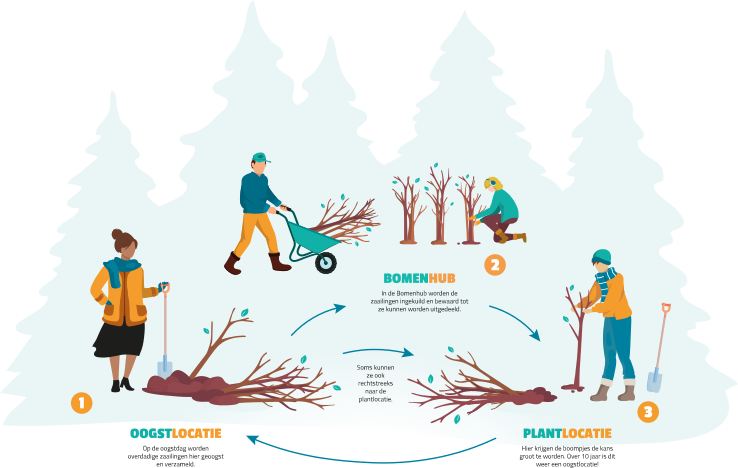
Nature produces a glut of young trees and shrubs each year. Every Oak, Beech, Hawthorn, Willow, etc. produces thousands of seedlings. Much of this young growth can be harvested and given a second chance to grow to maturity elsewhere. Often seedlings are removed to create clearings, because there are too many of a particular species or to make room for ground plants. More Trees Now likes to do this differently. By working with volunteers who carefully handle, sort and store the plants, the seedlings get a chance to become a mature tree or shrub elsewhere. In this way, we create free, mostly native and ecologically sound new nature.
Seedlings, shoots and advances /runners are saplings. To reproduce, a tree produces an abundance of seedlings. Most of these do not survive. For instance, they are in a place where they are unwanted, are out-competed or there are too many of one species in one place. They are often cut down, or uprooted and thrown into a shredder. We harvest these seedlings to plant them out somewhere where they can become mature trees.
You can help by partaking in harvesting or organising the harvest days. You can sign up for this in the Treeplanner There you can see information regarding activities in your area and sign up for them. As an organiser, you can plan these harvest days yourself and call on people to help!
As a company, you can choose to run a sustainable team outing : a day of harvesting or planting with your team. Your company can also sponsor More Trees Now or request rescued trees to green your business park.
As a forester or site manager, you can help by registering the land you manage as a harvest site where we come to help harvest seedlings during the winter.
Municipalities wishing to participate can send an email to [email protected]. We will then schedule an appointment to explain how you can participate as a municipality. Consider, for example, organizing a Tree Hub, arranging the green policy so that no more seedlings are lost by harvesting before mowing and when pruning, keeping aside the ‘cuttable’ species, and replantable trees, for volunteers to pick up.
Schools, scout groups and other associations can participate as volunteers by signing up in the Treeplanner. If you would like to visit with a group or organize something yourself, please contact us at [email protected]. Then we will look together for a suitable harvesting or planting activity.
The Tree Planner is the digital environment for everyone who helps with More Trees Now. Each volunteer, harvest supervisor, Tree Hub and planting site has its own profile. With that profile you sign up for events such as harvest, distribution or planting days. You can also use your profile to create events: a Tree Hub can, for example, place a distribution day on the agenda.
Check the bar at the top of the site or go to the Tree Planner.
The Tree Planner shows all available activities in your area which you can participate in. For your convenience, you will receive by email an overview of all upcoming activities in your defined catchment area, every Wednesday evening at 6 p.m. CET (from late October to late March).
After registering in the Tree Planner, you can now start organizing harvest events yourself! Once you login to the Tree Planner click on Harvest Locations on the side bar, then you can enter your details once you click on button “+Add” Having problems still ? Contact [email protected]
The season starts in early November. In the Tree Planner you can see where harvest and distribution days are in your area. You can join these events and organise to pick up available trees via the Tree Planner.
The season starts in early November when the trees are dormant. The Tree Planner shows you if there are harvest and distribution days in your area. You can pick up trees at a harvest day venue, or at a Tree Hub near you. Sign up for these events or use the chat function in the Tree Planner to coordinate with us if anything is unclear. Keep an eye on the Tree Planner and emails starting early November for your trees!
There are many public distribution events where anyone can pick up free tree saplings without signing up in the Tree Planner. Check out the calender or the newsarticles. Also, you can help with harvesting and then take home some of the harvested trees or shrubs by mutual agreement. You can also create your own planting location in the Tree Planner.
If you do not want to receive the weekly mail, go to your profile in the Tree Planner. Scroll down the page and on the right you will see a section : ‘Contact Moments’ where you can toggle on/off the communications you wish to receive.
At the bottom of each newsletter is a link (required by law) to unsubscribe.
If you have a large amount, then sign up as harvest location. If there are just a few then you can hand them in at one of the harvest days in your area.
There are many possibilities in natural areas, gardens, city parks…. But! First you must request permission from the landowner /Manager. Harvesting in managed areas such as nature reserves, city parks and estates is allowed only with permission and under the supervision of a forester, ecologist or harvest supervisor. After all, they know best which species and numbers are wanted and which are not. On your own property, of course, you may harvest and cut to your heart’s content.
You are not allowed to harvest seedlings or cuttings just anywhere. This requires permission from the site manager/owner. Can you track down the groundskeeper /owner and maybe even enthuse them to participate? If so, that would be super! Then these people can sign up as harvest sites on the website. More information about harvesting events.
We harvest everything, but we don’t hand out everything. When harvesting we try to create a win-win for site managers by, for example, also pulling out the American Bird Cherry, an invasive exotic that most site managers would really like to get rid of. However, these ones will end up on the compost pile. What we hand out is mostly native and always ecologically sound. Non-invasive non-native species can often still find a safe place in backyards and some food forests. We always recommend planting sites choose a diverse mix with early and late bloomers, fast and slow growers and fruit-bearing species such as Elderberry, Cherry, Hawthorn, etc. for maximum benefit to insects and birds.
In Willows and Poplars, the canes are called “slites”. Branches 1 to 3 meters long are inserted 40-60 cm deep into moist soil. Read more about harvest or donating seedlingss.
Harvested trees are brought to or picked up and taken to a Tree Hub: a temporary storage site from where they are distributed. Planting locations can also sign up to pick up the harvest directly. Anyone can sign up as a planting site. These are mostly food forests, farmers and private initiatives but also, for example, a community organisation or someone picking up a tree for their own backyard. We also sometimes plant roadsides with a municipality.
Ecologists are (rightly!) concerned that too few original native trees are being planted in the Netherlands and throughout Europe. They estimate that only 2 to 3 percent of Dutch forests consist of native wild trees and shrubs. The rest are cultivated in the Netherlands or imported.
Let’s all protect these last bits of native greenery. Or rather, let’s protect all existing nature and all old trees. And let’s use these pieces of nature as starting material for new nature.
More Trees Now collects seedlings in places where they are shaded, too close together, too close to paths, at demolition sites and other places where they are undesirable. The seedlings then go in a diverse and native mix to farmers and citizens who plant them again.
What we collect is 90% native from places where they grow in abundance. We don’t know if it’s all indigenous. We can’t determine that, because that would require genetic research and we don’t have time for that. We are in an ecological as well as a climate crisis. Every native healthy tree that has grown up in nature (and thus without poison or fertilizer) and that we can give a better chance elsewhere, offers added value. Added value for insects, soil, birds, planet and people.
10% of what we transplant is not native. This is not a bad thing, because food forests want to plant exotics, and exotics can do little harm in urban gardens as well. And even the best wood for the sustainable homes of the future often comes from exotics. We pull out invasive exotics also when we are collecting native species. That way we have a win-win.
Because the only thing worse than a cultivated hawthorn or birch is no hawthorn or birch just concrete. We keep talking to see what we can do even better together. What is paramount is that we need more forest and more nature!
NB: Native means that the genetic material of the tree originates in the country. Native means that the tree can thrive in our climate and grows here naturally. Native trees are always native, but native trees are not always autochthonous.
We have found that harvest days on Wednesdays, Fridays, Saturdays and Sundays have the most volunteers.
We also recommend sharing your harvest event on social media (especially LinkedIn) and inviting other green groups such as IVN, Nature Society, Nature & Environment Organisations, local landscapers, Green Churches and other sustainable groups. You can share your event using the link in your event created in the Tree Planner.
A Tree Hub is a place where harvested and sorted seedlings are stored and then distributed from there. Harvest supervisors bring the seedlings here, people with a planting location come here to pick them up. In your Tree Planner profile, as a Tree Hub, you indicate when pickups and deliveries can be made. How often your Tree Hub will be used, will depend on the amount of harvesting and planting locations in your area. Would you like to organize a Tree Hub? Sign up here or read more about Tree Hubs.
Great! Sign up as plant location and see which Tree Hubs have distribution days scheduled. Want to plant in public spaces? Be sure to coordinate with the landowner/local authority. This is necessary to prevent the trees and shrubs from being removed and ending up in the chipper. Sin! Ideally, look for a spot where you are sure that the trees and bushes can continue to grow old.
We remove seedlings from places where they are not wanted and give them a second chance in a desirable place. This method has been successfully used by the MEERGroen Foundation in the Netherlands for over a decade. Research over the past seasons shows that we have an 80% success rate.
Any exotics we might offer go to urban areas (for example, in backyards and parks) where nature is cultivated. In woodland plantings, hedges, hedgerows, etc., only the native species appropriate to that specific landscape are offered. Any invasive exotics are put in a rubbish or compost pile.
We harvest everything, but we don’t hand out everything. We try to create a win-win for site managers by, for example, also pulling out the American Bird Cherry, an invasive exotic that most site managers would really like to get rid of. However, this one ends up on the compost pile. What we hand out is mostly native and always ecologically sound. Non-invasive non-native species can often still find a safe place in backyards and some food forests. We always recommend planting sites choose, a diverse mix with early and late bloomers, fast and slow growers and fruit-bearing species such as Elderberry, Cherry, Hawthorn, etc. for maximum benefit to insects and birds.
We have two categories that we plant: seedlings with roots and cuttings/slips. The seedlings with roots should be planted so that all the roots are below ground but also not much deeper than that. The cuttings/slips should be put 1/3 into the ground.
The first two years it is important that the seedlings/ cuttings get enough water during the dry periods. This is because the first two years the root system still needs to develop properly.
This depends on the type of landscape element you are creating. In a wooded bank, for example, the seedlings are closer together than a forest. On average, for forest plantings, plant 1 tree per 1 to 3 m², depending on species and purpose.
Use the Tree finder on the site to find the species that best suit your needs and environment. In the Tree Planner, you can see which species are available for pickup by harvest location and Tree Hub.
Yes, definitely. Check through the Tree Finder on the website to see which tree species are toxic to horses and indicate this when signing up. This way we will make sure no trees are picked up that are toxic to your horse.
No, because our trees do not come from a grower. However, we do know where the little trees/seedlings come from, they are pesticide and fertilizer free and completely circular! Nature “grew” them for us for free. Some parties are required to use certified trees for a project. They then often order (tens of) thousands of certified trees at once. With us, the largest numbers of trees usually go to farmers and food forests. So we complement each other well!